Interior of the Sahebgharaniyeh Palace, circa 1860 by Antoin Sevruguin -
Mehrdad Aref-Adib:
After colourising the photograph of the Mirror Hall (Talar-e Aineh), I noticed an unexpected connection that stretches from nineteenth-century Tehran back to the Spanish Golden Age. Photography arrived in Iran in 1844 with the Frenchman Jules Richard, whose lost daguerreotypes of Mohammad Shah and the young Nasir al-Din Mirza helped spark the court’s fascination with the new medium. By the 1850s and 60s, European instructors at the Dar al Funun were teaching the latest photographic techniques. Dar al Funun, Iran’s first modern polytechnic founded in 1851, became a crucial gateway through which European scientific and photographic knowledge entered the country. During this period, Naser al-Din Shah, newly crowned and endlessly curious, became an enthusiastic practitioner with his own palace studios and official court photographers. By the 1870s, independent studios such as those of Joseph Papaziyan and Antoin Sevruguin made Tehran a lively centre of visual experimentation. It was within this rich photographic culture that the Mirror Hall image was created, an image that, perhaps unintentionally, echoes the philosophical and optical puzzles of Las Meninas.
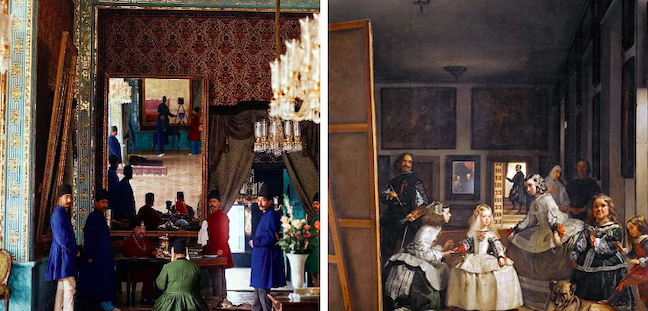
In Velázquez’s 1656 masterpiece, we are drawn into a private moment in the Spanish palace. The young princess and her attendants hover in mid gesture, while Velázquez himself pauses at his canvas as though just noticing our arrival. The realism is so persuasive that we seem to stand where the King and Queen would have stood, their presence revealed only by a distant mirror. Yet Las Meninas is not simply a snapshot of court life. It is a self-aware meditation on artifice, perception and the act of looking. Velázquez includes himself deliberately, exposing the constructed nature of what appears real.
The Iranian photograph, when examined closely, reveals a similar tension. At the centre of the composition, Naser al-Din Shah the seated figure looks directly towards the camera, fully aware of the lens trained upon him. But in the mirrored surface behind him we see only the photographer’s reflection standing beside his large-format camera on its tripod. The architecture of the Qajar court has pulled the maker into his own image, rather as Velázquez painted himself into his, although here the inclusion is not a conscious artistic gesture but an optical inevitability. The mirror refuses to let the photographer disappear.
Velázquez worked with brush and pigment to simulate a moment of lived reality, while the Qajar photographer used a machine to record actual light and time. Yet both creators found themselves caught inside their own works, each made visible by the very tools intended to frame others. The illusionist reveals his hand; the documentarian becomes part of the document.
Across centuries and across mediums, these two works meet on a single insight. Whether through the deliberate brushstrokes of seventeenth-century Madrid or the reflective architecture and mechanical lens of nineteenth-century Tehran, every image carries the presence of its maker. No scene is ever neutral, no viewpoint solitary. There is always someone just outside, or inside, the frame, watching >>> Mehrdad Aref-Adib










Comments