National Baha'i Center in Tehran before its destruction
From Under the Staircase: A Martyr's Journey by Farsheed Ferdowsi
On December 5, 1954, after settling the oil dispute with the Anglo-Iranian Oil Company, and a month after the death of his brother in a plane crash, the shah and Queen Soraya set out on their long-anticipated trip to the United States. What was publicized as a vacation was in fact a trip to seek a medical examination and possible treatment for Queen Soraya’s infertility. To the dismay of the royal couple, they were told definitively that Queen Soraya could never have a child. The rest of the three-month sojourn in America was spent on travel and leisure.
It turns out that two minor events during their vacation would become the impetus for a new wave of persecution of the Baha’is in Iran. While in Miami, a photographer took pictures of the young queen waterskiing in a scanty bathing suit. The shah’s entourage tried to purchase the negatives, but they were not successful and the images appeared in a weekly magazine. In another unrelated episode, a woman claimed to have the shah’s child. This baseless claim also found its way into a tabloid. The political price of these tabloids became evident a few months after the royal couple returned home. Two senior clerics, Ayatollah Borujerdi and Ayatollah Falsafi, used the articles to blackmail the shah into sanctioning attacks against Baha’i centers in Tehran and throughout the land, or else they would disseminate the material all over the country, embarrassing the royal family. The shah blinked.
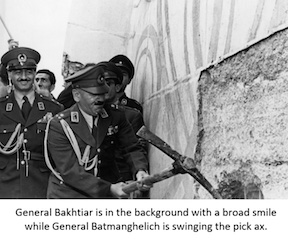 From May to June 1955, during the Ramadan period, a systematic program was launched against the Baha’is by the clergy in cooperation with the government. The principal instigator of the attacks was Grand Ayatollah Borujerdi, the leading religious leader in Iran at the time. He instructed Ayatollah Falsafi to use his live radio sermons, broadcasted nationwide on civilian and military channels, to attack the Baha’i Faith as a “false religion” and the enemy of Islam. The relentless drumbeat of slander and hate speech riled the population into a frenzy against the beleaguered community. The government confiscated Baha’i properties in every city. In Tehran, in front of the cameras of both foreign and domestic reporters, General Batmanghelich, the chief of staff of the Iranian army, along with General Bakhtiar, the military commander of Tehran, took pickaxes and started the process of demolishing the dome of the Baha’i Center.
Aside from the destruction of the national Baha’i Center in Tehran and confiscation of Baha’i-owned properties all over the country, believers also suffered sporadic acts of violence. Murders, rapes, injuries, and robberies were reported in various cities. Countless Baha’i homes and businesses were vandalized or burned. Baha’i cemeteries were bulldozed and desecrated. Corpses were dragged in the streets and burnt, once again demonstrating one of the most appalling fixations of the Shias, where even in death one cannot escape their hate. The House of the Báb in Shiraz, the foremost Baha’i shrine in Iran, was looted and severely damaged. There were several laws proposed before the Majlis that would make it illegal to be a Baha’i, punishable by two to ten year prison terms. But fortunately, these bills did not pass.
In open letters, leading Ayatollahs heaped praise on the shah and the army for these praiseworthy “acts of service” to Islam. In his open letter, Grand Ayatollah Borujerdi described the Baha’i Faith as a conspiracy that endangered the state as much as Islam. He called for a total purge of Baha’is from all public sector positions.
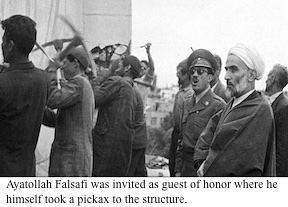 The reaction of the Baha’i world was swift and intense. Hundreds of communities throughout the world vigorously protested the actions of the Iranian government. Where possible, they appealed to their respective governments to lodge formal complaints with the Iranian regime, condemning such overt violations of basic human rights. In this campaign, they were joined by the leading international newspapers. The secretary general of the United Nations, Dag Hammarskjöld, and the US State Department pressured Iranian government to stop the attacks. The regime was surprised by the extent of the protest its actions had aroused around the world. It denied government complicity and the involvement of the army in the attacks. But pictures of army generals with pickaxes were impossible to ignore.
The Iranian government, dependent on foreign aid and support, found it difficult to resist international pressure. Ignoring the domestic political price, it halted the attacks on the Baha’is. Soon the crisis subsided while the shah learned a painful lesson. Never again did he overtly join the clergy in persecuting the Baha’is. This episode and some of his future programs set his relationship with the clerical establishment on a downward course.













Comments